
Masike
Quiet-Voice Engine
Scroll
Masike
Scroll
II
A pair of AI glasses with a camera, that also records offline.
Allwinner V883 · 12MP 4K photos · offline recording, no network needed · under 40 grams · adult and child sizes

The first in the world
The adult and the child version are the same glasses — same camera, same two microphones, same lens options. Only the size differs.
The child size.Cut for a child's face, narrower at the bridge and at the temples. It takes a prescription just the same — plenty of children already wear glasses.
The adult size.The proportions of ordinary indoor eyewear.
Why nobody has made this.There are children's watches with cameras, and there are children's devices that record. A pair of glasses a child can use outdoors to catch a flower, a bug, a leaf — with nothing at all depending on a network — has not been built yet.
About a child's privacy.The recording captures the wearer and nobody else, in hardware: what your child says is recorded, what the classmate beside them says is not. That is the same answer for a parent and for a school.
Camera
Not "it can also take a picture". Every trade made on this pair — which chip, which sensor, which lens, whether to do long video at all — was settled by that one question.
Whether a photograph is any good comes down to three things and only three: the chip, the sensor and the lens. Each one is below, with what we chose and what the choice bought.
Chip
A quad-core CPU and 4 TOPS on-device. Neither number is what matters, though — what matters is which jobs it does in silicon.
AI-ISP.Noise reduction, wide dynamic range and colour are settled at the moment of capture, not repaired afterwards. This is where the same sensor on two different chips ends up a class apart.
PDAF phase-detect focus.Raise your hand and press; no hunting. Most photographs taken on a pair of glasses are snatched, and a slow focus means the moment is gone.
Electronic stabilisation.You are walking while you shoot, not bracing.
4K encoding.Enough for stills and for five-second clips, with headroom left over.
What a flagship phone SoC is good at is running a large model on the device itself.
Our AI is not on the glasses. It is on the phone. The glasses do one job: get the frame down cleanly and hand it over.
So what we want is not a chip that thinks, but a chip that gets the frame down clean — AI-ISP, phase-detect focus, stabilisation. That is what a photograph rests on. The cost and the power we did not spend went into the sensor, the lens and the battery.
Sensor
On a sensor this small, pushing the pixel count up is the easiest thing to do and the least useful.
And how much light one pixel catches is what decides the noise in low light, and how much of the highlights and the shadows survive together. Twenty megapixels on the same piece of silicon means every pixel catches half the light. A better spec sheet, a worse photograph.
So we spent the budget the other way: a larger area per pixel. Clearer by day, cleaner at dusk and indoors.
A 4K still off twelve megapixels is more than enough on a phone, on social platforms, printed at six inches. What actually makes you think "this one is no good" was never the resolution — it is noise, a blown-out sky, mud in the shadows. All three belong to the sensor and the chip, not to a pixel count.
No pixel race and no long video means an order of magnitude less data. Storage can be small, power draw low, the battery light — and the end of that chain is the 40 grams on your face.
Lens
Glasses do not need a zoom — turning your head is the zoom. And a zoom means a motor, a longer barrel, more moving parts: three things that add weight, drain power, and break.
Take it out and the assembly gets thinner, lighter and sturdier, and the optical path is easier to get right. A very good trade.
Because there is no viewfinder. When you raise your hand and press, you do not know where the edges are — wider means you do not cut off half of someone's head. Catch it first, crop on the phone. You can crop away; you cannot put back.
It decides whether dusk, indoors and under the trees — the not-very-bright places you still want to shoot — are usable at all. However good the sensor is, it is no use if the light never arrives. These two have to be given together.
All-plastic elements are cheap, but they smear at the edges and fringe purple. Glass elements push both of those down, at the price of a little more cost and a little more weight. On a pair of glasses you take out to make pictures with, we accept that price.
What it is
Photographs.4K stills. One press and it is done — no phone to pull out, no lock screen, no app to open.
Recording, and no network for it.It is written to the glasses' own storage and never touches the network. No signal in the mountains, a phone switched off on a plane: it records anyway.
Two microphones, both on the front frame.The main mic sits at the bottom centre of the left rim, port facing down at your mouth, 4–7 centimetres away; the reference mic sits on top of the right rim, port facing up and away from your mouth, much further from it. Which is why you can speak very quietly.
Two speakers.In the temples, near your ears, aimed at the ear canal. Music, podcasts, calls — like any other Bluetooth headset.
It is a pair of glasses first.A TR90 frame in the proportions of ordinary indoor eyewear, UV400 lenses, and any correction you need — myopia, hyperopia, astigmatism. You were going to wear a pair when the sun came out anyway.

So far, the only pair
AI glasses with a camera exist. Audio glasses that record exist. Doing both at once, with recording that depends on no network at all, is so far this one pair.
Recording on those other glasses is, in essence, lending a microphone to a phone — with the phone elsewhere, out of signal or in flight mode, nothing is kept.
Ours is written to the glasses' own storage. It never touches Bluetooth and never touches the network. No signal in the mountains, none in the metro, a phone switched off on a plane: you press once and it records. It syncs when you are back somewhere with a connection.
The same holds for the photographs: taking one does not need a phone connected. The glasses store it first and send it later.
Only you
One main mic at your mouth, one reference mic facing away.The level difference between them decides. Walking down the street, sitting in a café, in the middle of an online meeting — the result is the same. What was recorded is only you.
You can be very quiet.Quiet enough that someone half a metre away cannot hear you, and it still records you clearly.
Which makes it wrong for meetings.Several people brainstorming, an interview, a lecture: this pair cannot do it, and you should use a voice recorder. That is not a flaw, it is the other side of the same decision.
Online meetings, though, yes.If you want your own half of a meeting kept separately, it is exactly right — what gets recorded is the part you said.
Two microphones
The main mic sits at the bottom centre of the left rim, port facing down at your mouth. Depending on the size of your face that is 4 to 7 centimetres.
The reference mic sits at the top corner of the right rim, port facing up and tilted back, away from your mouth. About twelve centimetres.
When you speak, your voice reaches the main mic 7 to 9 dB louder than the reference. When someone half a metre away speaks, both microphones are almost the same distance from them, so the difference is under 1 dB. The threshold sits at 4–5 dB. Below it, nothing is written.
That is the whole privacy design. No DSP, no beamforming, no voiceprint, no model, no cost. And no way to switch it off — because it is not a setting, it is where the holes are.
Quiet-Voice Engine
Worn, 4–7cm. Held up to your mouth, 2–3cm. Same microphone, one gesture.
Geometry beats every noise-cancellation algorithm.
Photographs
That is a deliberate product decision, and a new one.
4K stills.There is one action on the glasses: take a photograph. Press when you want one; everything else happens on your phone.
Interval shooting, cut into a sequence.Set it on your phone — one frame every three seconds, say — and it keeps going by itself. What comes back has a rhythm to it, instead of an hour of footage nobody wants to watch twice.
Five-second clips.There for when something has to move. But no long video — that is not what glasses are for.
Why not 4K video.Continuous video will not fit, costs far more power, and shakes the whole time you are walking. Interval stills, aligned on the phone, come out much steadier.
Weight
The decision to shoot stills and not long video pays off least in storage and most on the scales.
Power draw falls by an order of magnitude.Continuous 4K encoding holds the chip at full load for a long time; interval stills let it drop back into deep sleep between frames.
So the battery can be small.A battery is one of the heaviest single parts in a product like this. Nothing has to be powered through continuous video, so nothing has to be enlarged.
So nothing has to make room for heat.Little heat means no extra thermal structure and no metal parts — the things that take up space and weigh on the scales.
The frame and the lenses are small too.These are the proportions of ordinary indoor eyewear, not a sports wrap. A smaller rim means a smaller lens; and lens weight grows with area far faster than the frame's does.
It adds up to under 40 grams — with a camera, two microphones, two speakers and local storage inside, 4K photographs and short clips, and recording that works when there is no network at all.
Among AI glasses of this kind, it is one of the lightest. We do not say the lightest — that word is always being taken by a smaller battery and fewer features.

Ecosystem
Sike is our own app. It is the first thing the hardware connects to — pairing, pulling photographs, pulling recordings, managing the device.
But making pictures, taking notes, keeping records: we do not intend to build all of that ourselves. The platform is open, and phone, desktop and even purely web-based apps are all welcome on it.
The arrangement is a simple one. An app that joins gives our hardware owners a free one-year super VIP code. We pay for it; the owner pays nothing.
These apps publish super VIP at somewhere between ¥100 and ¥300 a year. Buy one pair of glasses and what you get is a year of super VIP across many of the apps in the ecosystem — several thousand yuan, added up.
The full list of ecosystem apps is being announced.
An ecosystem app
The glasses get the frame down cleanly; making a picture out of it belongs to the people who do only that.
It works without a subscription. Shooting, organising and exporting are all free. Only the advanced features need super VIP — and that year is already paid for.
Open
We publish the interface documentation and a development kit. Pull the photographs, pull the recordings, trigger the shutter — a developer gets the same set we use ourselves.
What a pair of glasses can do should not be decided by the people who make the glasses. We do not plan to build any of these, and every one of them is buildable:
Naming plants and animals in the field.A child sees a plant they do not know and presses once. What comes back is a list of names with pictures.
Picture notes.A line or two with every photograph, spoken or typed. Picture and words together are worth more than either one kept alone.
Time outdoors.An app that does exactly one thing: record how long you were really outside each day.
A food diary.An hour over a meal, twenty frames, and it becomes a food diary by itself — one you can also hand to a health analysis.
The developer documentation goes public before we ship. Write to us if you want it sooner.
Colour
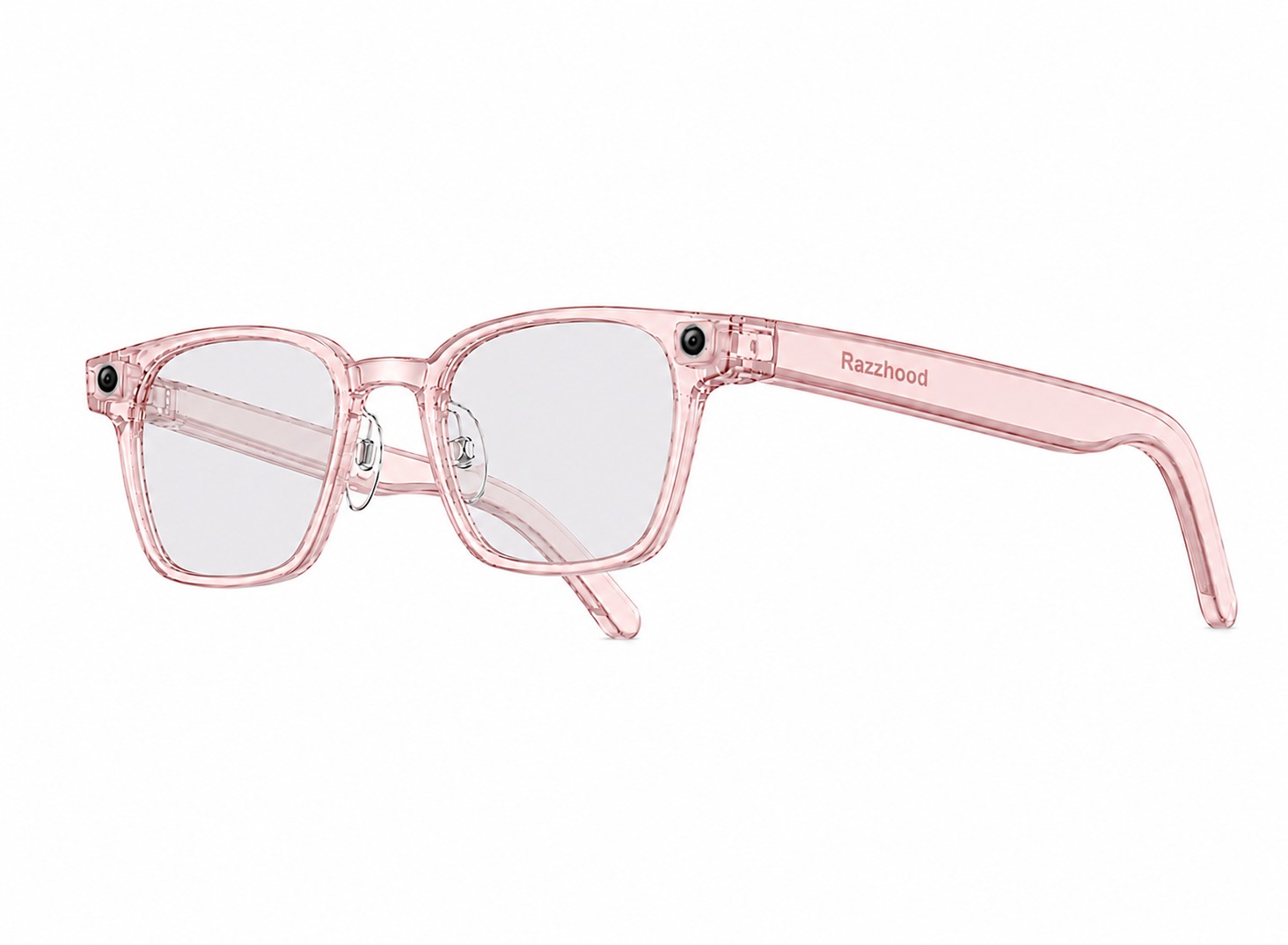
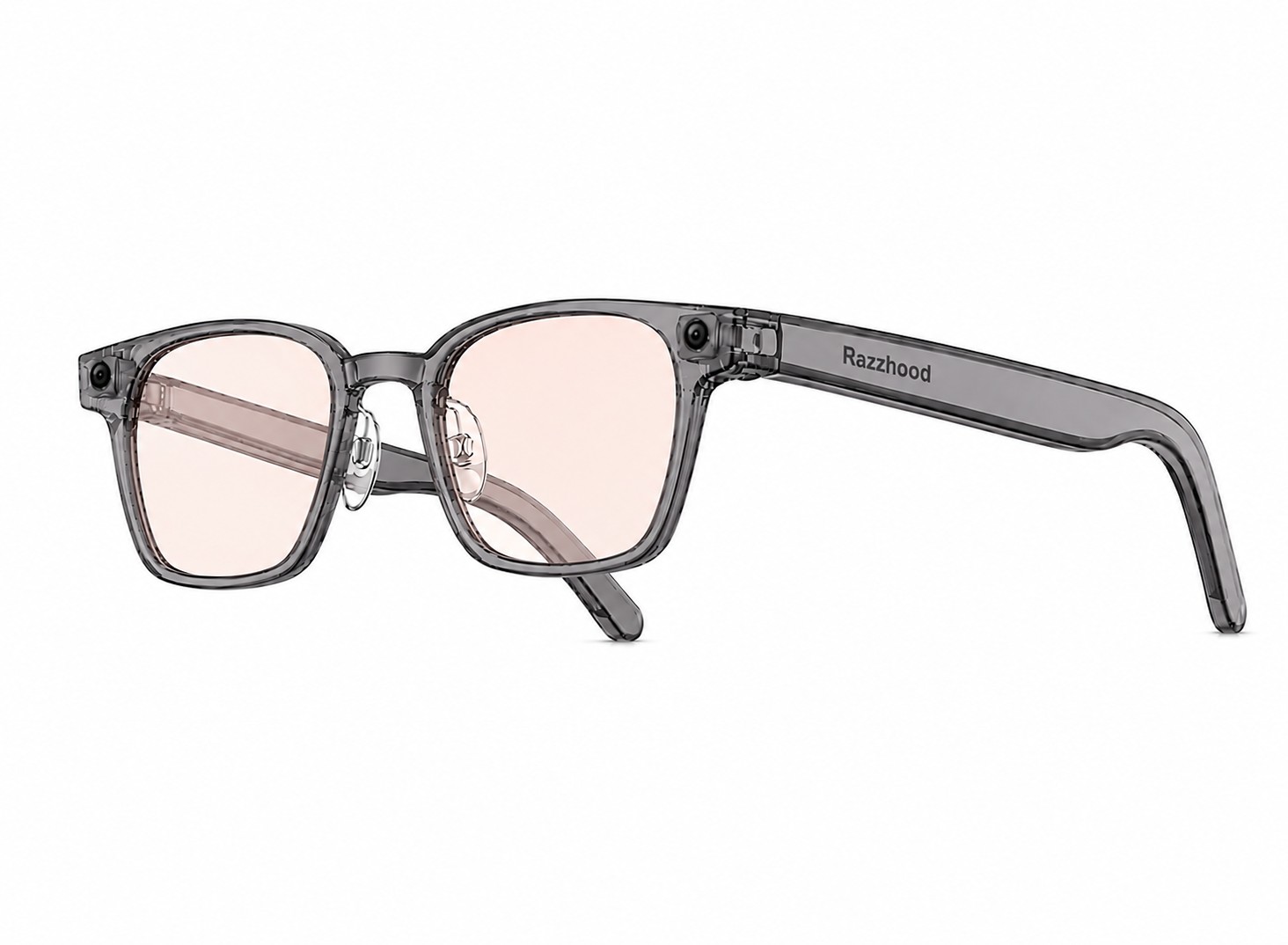
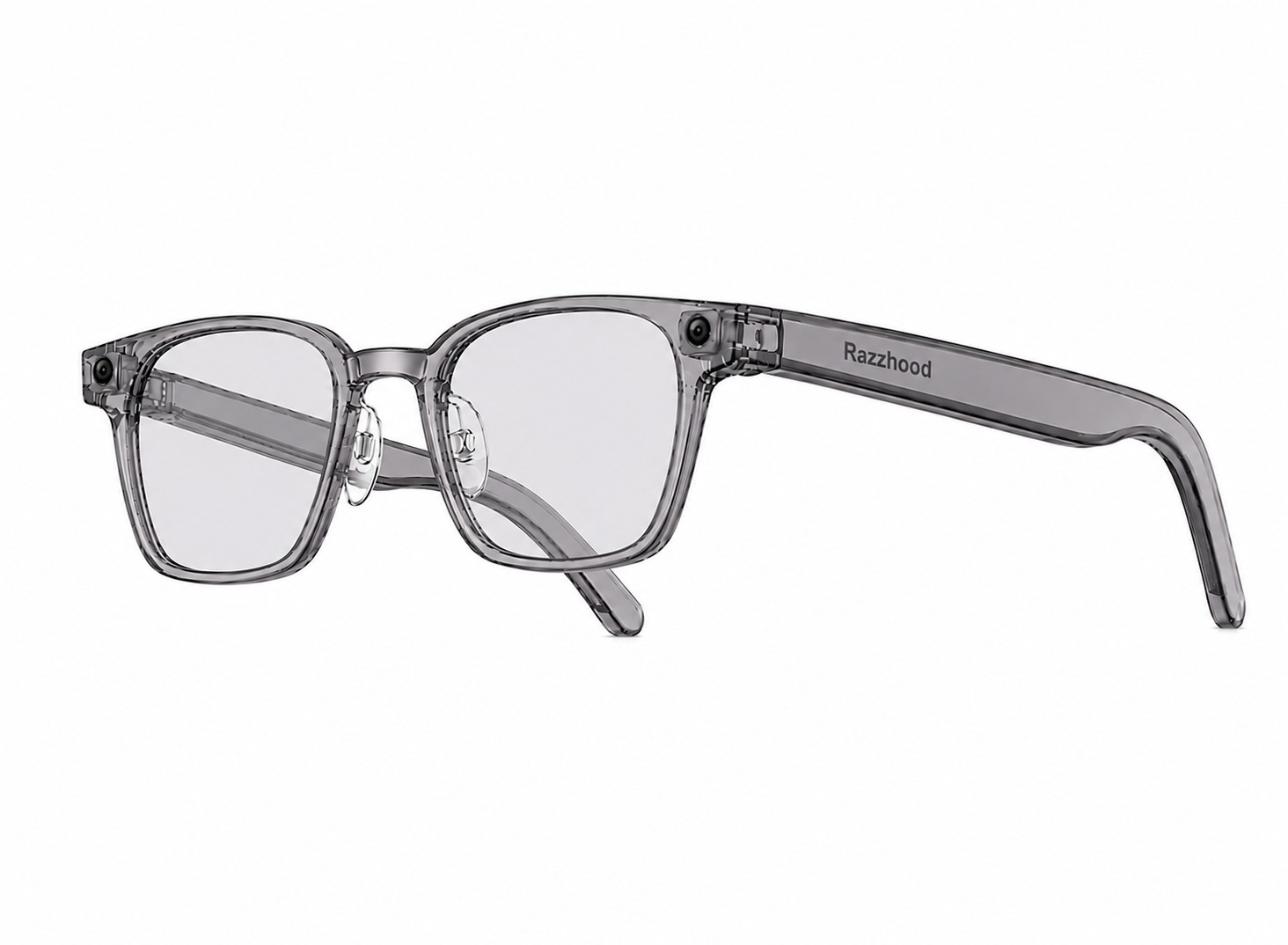
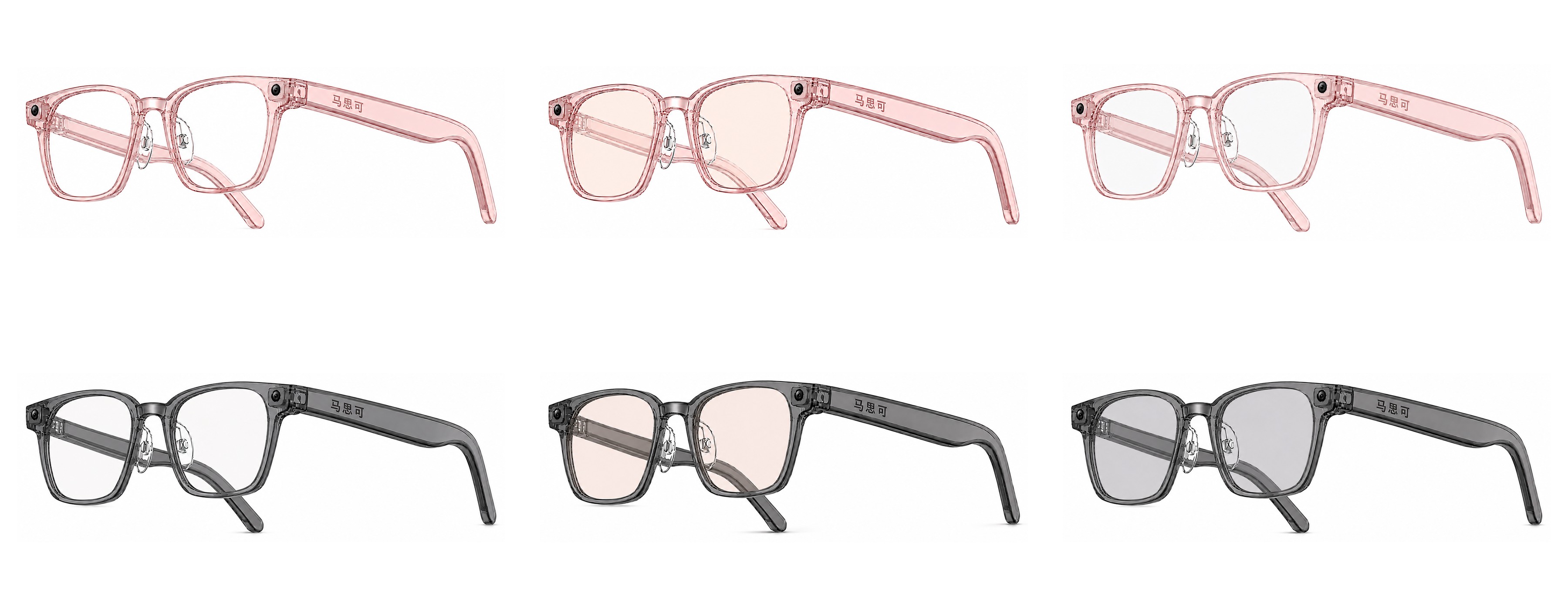
Space Gray.It reads more expensive than black, and it is already the colour of the phone and the laptop most people have in front of them.
Light Pink.Not a women's colourway. Warm rather than loud.
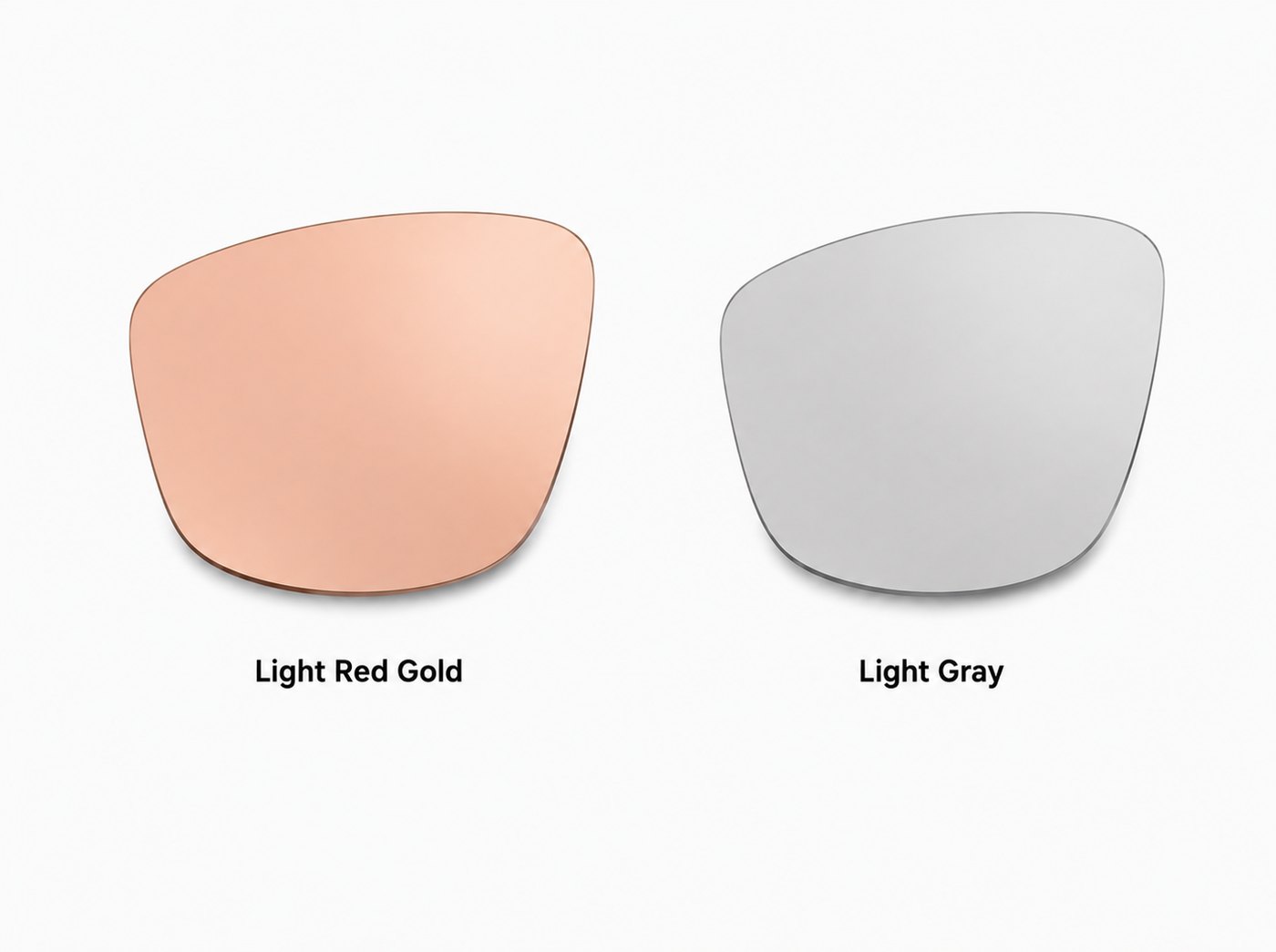
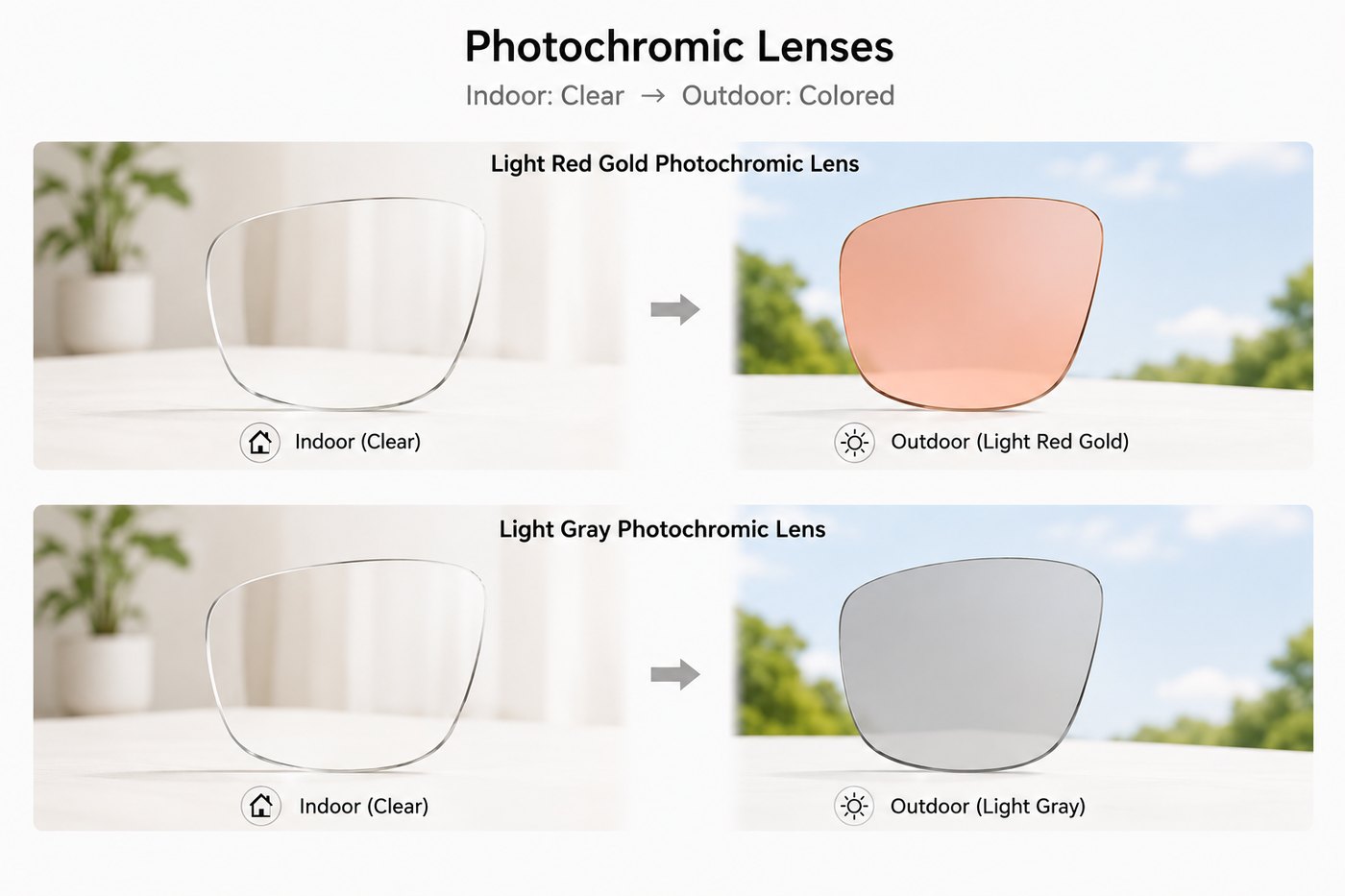
Lenses.Clear UV400, Light Red Gold, Light Gray. Tint +¥70, photochromic +¥140, prescription from +¥180.
Why the lenses are pale
Sunglasses have one setting. These have a headset inside them, which changes two things — and both push the tint lighter.
Indoors.Sunglasses come off when you walk inside. These cannot — you might be mid-call or mid-podcast, and pulling them off ends it. So the lens has to be liveable under a ceiling light, which a dark lens is not.
Outdoors.You still have to look at your phone. A dark lens sends the glasses up onto your forehead every time; a pale one shades your eyes and leaves the screen readable. In strong sun you stop noticing the tint is there at all.
Photochromic.The complete answer to the doorway: clear inside, sunglasses outside, no gesture required. ¥140 more, in either tint.
Not gradient.We asked. The fashion creators were blunt — a gradient lens reads middle-aged. Photochromic is the version of the same idea that does not, because it is not a permanent gradient. It is a clear lens until it is not.
Frame
TR90.The nylon that high-end American outdoor eyewear is built from. Very light, very resilient, and it flexes back instead of taking a set. Not the cheap plastic the word "nylon" suggests.
Not titanium.There is a microphone inside the front frame and electronics down both temples. A metal frame with wiring threaded through it is a harder problem for no gain we could find.
Not a sports wrap.Traditional outdoor eyewear is thick, wide and heavy, and a wide frame forces a wide lens — which is where the weight actually accumulates. We used the proportions of an ordinary indoor frame instead. Smaller rim, smaller lens, weight saved at the source.
Build your pair
Retail ¥1,250 a pair. The early-bird code is not public — it exists only inside a creator's invite link or code.
Preorder
AI glasses that photograph, and record with the network gone. One pair.
Retail¥1,250
You pay¥1,250
Ships30 November 2026
SizeAdult or child, chosen at checkout. The hardware is identical
IncludedA year of super VIP in the ecosystem apps, free. The list is being announced
In the boxGlasses with clear UV400 lenses fitted, magnetic charging cable, case, cloth
Lens upgradesTint +¥70, photochromic +¥140, prescription from +¥180
ShippingFree nationwide. No shipping, packaging or handling fee within mainland China
The early-bird code is not public — it exists only inside a creator's invite link or code. You pay now and the glasses ship in November 2026. If we are more than sixty days late, we refund you without being asked.
Prescription
Myopia, hyperopia, astigmatism, or anything else you need. Prescription lenses start at +¥180.
Card one
Pick it now, left and right eye separately.
Left eye
Right eye
Not chosen yet
Your optometrist's numbers are what we cut to; we confirm with you once after the order before anything is made. If you are unsure, leave it blank — we will be in touch.
Card two
The kind where small text stops being readable. Left and right eye, separately.
Left eye
Right eye
Not chosen yet
Progressives are available too — distance on top, near at the bottom. If progressives do not suit you, we suggest two separate pairs: one for distance, one for near.
Card three
Astigmatism, and everything the first two cards cannot hold.
Cylinder and axis
Myopia plus hyperopia, progressives
High-index material for strong corrections
Unusual PD, large difference between the two eyes
More lens colours — three to begin with, more opening up over time
None of this needs a checkbox. Leave us a note with the order, or email us a photo of your prescription now, and we will confirm everything before cutting.
Email usOn hyperopia
You assumed it was the late nights. You assumed you had not slept enough. In fact you may already be slightly long-sighted.
For some people it starts at thirty-eight, for others forty-five, for others fifty. The awkward part is this: if you need a correction in your thirties or just past forty, you would rather nobody read your glasses as reading glasses.
But you are wearing a pair of AI glasses. That changes the reading entirely.
Get tested at an optician — that is the accurate route. Or, more simply, try the ready-made ones in a shop: whichever feels comfortable is the one for you. Hyperopic powers change slowly and vary little between people, which is very unlike myopia.
The real problem is that if you never wear a correction, you never notice. Small text becoming unreadable does not arrive as the thought "I should get glasses". It seeps into your work, your reading and your evenings: the menu read twice, the instructions skipped, the phone font pushed larger and larger, reading at night getting steadily more tiring.
You can have progressives: distance power (or plain) on top, near power at the bottom. One pair, two jobs.
But some people never get on with progressives — the edges swim, and stairs need a chin adjustment. So we offer the other route: two pairs, one for distance and one for near. Plenty of people end up there.
Think of us as an optical shop. A professional, young, fashionable one that happened to put a recording button on the temple.
Lenses
Polarised lenses darken phone screens, sometimes to black. This is a product you look at your phone with — to sync, to look through the photographs, to edit them. So both tints are UV400, not polarised, and they cost half as much to make.
A dark lens without UV400 is worse than no lens at all: the darkness opens your pupil and lets more ultraviolet in. Every Masike lens is UV400, in both tints, at every price.
Shipping
Mainland China.Free shipping nationwide, with no packaging or handling fee.
One pair at a time.Many of these lenses are cut to one person's own prescription, and a pair ships once it is made. That is not an efficiency problem; it is what the optical trade has always been.
Everywhere else.Not yet. Every market needs its own radio certification, and a warehouse on the ground abroad. We would rather do one place properly first.

Founder's Letter
Founder & CEO
My father built a chain of shops that rewound burnt-out electric motors. I grew up around copper, machines, and money. Very young, I became a video game merchant, trading weapons and gear across platforms.
I later backed the AI startup behind Lenovo Smart Router as an angel investor and sold part of my stake to Xunlei and JD.com. That experience gave me a first-hand feel for smart hardware, for wearables, and for what the words entry point actually mean.
A few months ago a friend — an AI researcher at OpenAI — told me what he needed: to talk to his coding agents anytime, anywhere. Not at a desk. Anywhere, and quietly.
Masike started with that sentence. It does not think. It catches what you said and hands it to you.
— Shishi
Questions
Two things. It also records offline — with no network at all. And the main mic is under the rim facing your mouth, only 4–7 centimetres from it, so you can speak very quietly.
No. Photographs are stored on the glasses first and synced later.
Five-second clips, yes. No long video — that is not what glasses are for, it will not fit, it costs far more power, and it shakes the whole time you are walking. For something worth watching, use interval stills.
No. The basics are free and only the advanced features need VIP. And every pair comes with a free year of super VIP across the ecosystem apps, DOKA among them.
No. One main mic at your mouth, one reference mic facing away, and the level difference between them decides; someone half a metre away never reaches the threshold. That is not a software filter, it is where the holes are.
The camera faces what is in front of you, and sees what you see. It is made for outdoors, and for being on your own. Please follow the rules of wherever you are — exam halls, secure sites and some museums do not allow camera devices.
Only the size; the hardware is identical. The child version is cut for a child's face, narrower at the bridge and temples, and it takes a prescription just the same.
Under 40 grams. That is what shooting stills instead of long video buys: the chip is never at full load for long, so the battery can be small and nothing has to be added for heat. Among AI glasses of this kind it is one of the lightest.
Yes, from +¥180. Myopia, hyperopia, astigmatism, progressives and unusual PD are all possible.
The interface documentation and a development kit — pull the photographs, pull the recordings, trigger the shutter. The documentation goes public before we ship.
The glasses are bought once. There is no monthly bill.